Best Picture: The New World Kings and Queen Innocence Caché A History of Violence Tropical Malady Keane Kiss Kiss Bang Bang Gilles’ Wife The Matador
Best Director: Terrence Malick, The New World Arnaud Desplechin, Kings and Queen Lucile Hadzihalilovic, Innocence Michael Haneke, Caché David Cronenberg, A History of Violence
Best Lead Performance, Female: Emmanuelle Devos, Gilles’ Wife Emmanuelle Devos, Kings and Queen Sibel Kekilli, Head-On Q’Orianka Kilcher, The New World Naomi Watts, King Kong
Best Lead Performance, Male: Damian Lewis, Keane Heath Ledger, Brokeback Mountain Robert Downey Jr., Kiss Kiss Bang Bang Viggo Mortensen, A History of Violence Choi Min-sik, Oldboy
Best Supporting Performance, Male: Jeff Daniels, The Squid and the Whale Mickey Rourke, Frank Miller’s Sin City Bruno Ganz, Downfall Oliver Platt, The Ice Harvest Mathieu Amalric, Munich
Best Supporting Performance, Female: Maria Bello, A History of Violence Robin Wright Penn, Nine Lives Qiu Yuen, Kung Fu Hustle Michelle Monaghan, Kiss Kiss Bang Bang Magali Woch, Kings and Queen
Best Screenplay: A History of Violence Kings and Queen Kiss Kiss Bang Bang The Matador The New World
Best Ensemble Performance: Kings and Queen A History of Violence The New World Games of Love and Chance Nobody Knows
Best Cinematography: The New World (Emmanuel Lubezki) The Intruder (Agnès Godard) Innocence (Benoit Debie) 2046 (Christopher Doyle) Kings and Queen (Eric Gautier)
Best Music: Tony Takitani (Ryuichi Sakamoto) The Beat That My Heart Skipped (Alexandre Desplat et al) Gilles’ Wife (Vincent D’Hondt) King Kong (Howard Shore) Pride & Prejudice (Dario Marianelli)
Best Cinematic Breakthrough: Sibel Kekilli (actor- Head-On) Lucile Hadzihalilovic (director/writer- Innocence) Q’Orianka Kilcher (actor- The New World) Michelle Monaghan (actor- Kiss Kiss Bang Bang) Richard Shepard (director/writer- The Matador)
Best Body of Work: Emmanuelle Devos (actor- Kings and Queen, Gilles’ Wife, The Beat My Heart Skipped) Heath Ledger (actor- Brokeback Mountain, Lords of Dogtown, The Brothers Grimm, Casanova) Werner Herzog (director- Grizzly Man, Wheel of Time, The White Diamond) Mathieu Amalric (actor- Kings and Queen, Munich) Joan Allen (actor- The Upside of Anger, Yes, Off the Map)
Best Cinematic Moment: Caché – “I just wanted you to be present” Oldboy – hammer time The Devil’s Rejects – “Free Bird” The New World – arrival of the English Kings and Queen – a letter from dad King Kong – Kong searches for Anne in NYC Kiss Kiss Bang Bang – Harry under the bed Kung Fu Hustle – the musicians Domino – Jerry Springer Last Days – “Death to Birth”
Best Picture: Dogville Before Sunset Kill Bill: vol. 2 Cowards Bend the Knee The Five Obstructions Primer Birth Los Angeles Plays Itself Eternal Sunshine of the Spotless Mind Zatoichi
Best Director: Lars von Trier, Dogville Quentin Tarantino, Kill Bill: vol. 2 Guy Maddin, Cowards Bend the Knee Richard Linklater, Before Sunset Jonathan Glazer, Birth
Best Lead Performance, Female: Bryce Dallas Howard, The Village Moon So-ri, Oasis Julie Delpy, Before Sunset Nicole Kidman, Dogville Esther Gorinton, Since Otar Left…
Best Lead Performance, Male: Jean-Pierre Darroussin, Red Lights Paul Bettany, Dogville Gael Garcia Bernal, Bad Education Jeff Bridges, The Door in the Floor Jim Carrey, Eternal Sunshine of the Spotless Mind
Best Supporting Performance, Male: Mark Wahlberg, I [heart] Huckabees Danny Huston, Birth Jude Law, I [heart] Huckabees David Carradine, Kill Bill: vol. 2 John Hurt, Dogville
Best Supporting Performance, Female: Coralie Revel, Secret Things Maia Morgenstern, The Passion of the Christ Eva Green, The Dreamers Daryl Hannah, Kill Bill: vol. 2 Cate Blanchett, Coffee and Cigarettes
Best Screenplay: Primer Before Sunset Dogville Eternal Sunshine of the Spotless Mind I [heart] Huckabees
Best Ensemble Performance: Dogville Anchorman: The Legend of Ron Burgundy Moolaadé I [heart] Huckabees Kill Bill: vol. 2
Best Cinematography: Birth (Harris Savides) Hero (Christopher Doyle) Father and Son (Aleksandr Burov) Collateral (Paul Cameron and Dion Beebe) Distant (Nuri Bilge Ceylan)
Best Music: Birth (Alexandre Desplat) The Incredibles (Michael Giacchino) The Life Aquatic With Steve Zissou (Mark Mothersbaugh and Seu Jorgé) Greendale (Neil Young) Bad Education (Alberto Iglesias)
Best Cinematic Breakthrough: Shane Carruth (director/producer/actor/writer/composer/editor/production designer/sound designer- Primer) Bryce Dallas Howard (actor- The Village) Moon So-ri (actor- Oasis) Coralie Revel (actor- Secret Things) Eva Green (actor- The Dreamers)
Best Body of Work: Lars von Trier (director/writer- Dogville, The Five Obstructions) Cate Blanchett (actor- Coffee and Cigarettes, The Aviator, The Life Aquatic With Steve Zissou) Jude Law (actor- I [heart] Huckabees, Closer, The Aviator, Sky Captain and the World of Tomorrow, Alfie, Lemony Snicket’s A Series of Unfortunate Events) Jamie Foxx (actor- Collateral, Ray, Breakin’ All the Rules) Nicole Kidman (actor- Dogville, Birth, The Stepford Wives)
Best Cinematic Moment: Before Sunset – Celine’s apartment Kill Bill: vol. 2 – the Bride vs. Elle Driver Birth – not a funny matter Dogville – Grace’s escape attempt Gozu – reach out and touch someone Enduring Love – balloon accident Anchorman – biker incident Notre Musique – Hell The Incredibles – Elastigirl infiltrates Syndrome’s lair Hero – attack on calligraphy school
Best Picture: The Son Irreversible Kill Bill: vol. 1 The Secret Lives of Dentists Lord of the Rings: The Return of the King Spider Bus 174 Stuck on You Gerry The Good Thief
Best Director: Gaspar Noé, Irreversible Jean-Pierre and Luc Dardenne, The Son Quentin Tarantino, Kill Bill: vol. 1 Peter Jackson, Lord of the Rings: The Return of the King David Cronenberg, Spider
Best Lead Performance, Female: Monica Bellucci, Irreversible Uma Thurman, Kill Bill: vol. 1 Oksana Akinshina, Lilja 4-Ever Angela Bettis, May Charlize Theron, Monster
Best Lead Performance, Male: Olivier Gourmet, The Son Johnny Depp, Pirates of the Caribbean: The Curse of the Black Pearl Nick Nolte, The Good Thief Campbell Scott, The Secret Lives of Dentists Matt Damon, Stuck on You
Best Supporting Performance, Male: Peter Sarsgaard, Shattered Glass Brendan Gleeson, 28 Days Later Albert Dupontel, Irreversible Sean Astin, Lord of the Rings: The Return of the King Sonny Chiba, Kill Bill: vol. 1
Best Supporting Performance, Female: Shohreh Aghdashloo, House of Sand and Fog Miranda Richardson, Spider Catherine O’Hara, A Mighty Wind Alison Lohman, Matchstick Men Ellen DeGeneres, Finding Nemo
Best Screenplay: The Secret Lives of Dentists Kill Bill: vol. 1 Shattered Glass The Son Stuck on You
Best Ensemble Performance: A Mighty Wind The Secret Lives of Dentists Kill Bill: vol. 1 Shattered Glass The Good Thief
Best Cinematography: Gerry (Harris Savides) Spider (Peter Suschitzky) Kill Bill: vol.1 (Robert Richardson) City of God (Cesar Charlone) Irreversible (Benoit Debie)
Best Music: A Mighty Wind (Various) The Triplets of Belleville (Benoit Charest) The Fog of War (Philip Glass) Spider (Howard Shore) Kill Bill: vol. 1 (RZA et al)
Best Cinematic Breakthrough: Oksana Akinshina (actor- Lilja 4-Ever) Angela Bettis (actor- May) José Padilha (director- Bus 174) Zooey Deschanel (actor- All the Real Girls) Anna Kendrick (actor- Camp)
Best Body of Work: Johnny Depp (actor- Pirates of the Caribbean: The Curse of the Black Pearl, Once Upon a Time in Mexico) Harris Savides (cinematographer- Gerry, Elephant) Matt Damon (actor- Stuck on You, Gerry) Hope Davis (actor- The Secret Lives of Dentists, American Splendor) Howard Shore (composer- Lord of the Rings: The Return of the King, Spider)
Best Cinematic Moment: Bus 174 – slow motion apprehension gone awry Gerry – rock marooned Gerry – sunrise shuffle Kill Bill: vol. 1 – the Bride vs. Go-Go Yubari A Mighty Wind – “A Kiss at the End of the Rainbow” So Close – “Close to You” in the record store The Son – Francis uses the air hose Kill Bill: vol. 1 – the Bride meets the Man From Okinawa The Secret Lives of Dentists – the flu spreads Spellbound – “your word is… Darjeeling.”
Best Picture: 8 Women 25th Hour Songs From the Second Floor Punch-Drunk Love Russian Ark Talk to Her What Time Is It There? Spirited Away The Piano Teacher Trouble Every Day
Best Director: Spike Lee, 25th Hour Francois Ozon, 8 Women Roy Andersson, Songs From the Second Floor Aleksandr Sokurov, Russian Ark Paul Thomas Anderson, Punch-Drunk Love
Best Lead Performance, Female: Isabelle Huppert, The Piano Teacher Samantha Morton, Morvern Callar Sylvie Testud, Murderous Maids Julianne Moore, Far From Heaven Summer Phoenix, Esther Kahn
Best Lead Performance, Male: Nicolas Cage, Adaptation. Ryan Gosling, The Believer Danny Huston, ivans xtc. Sam Rockwell, Confessions of a Dangerous Mind Edward Norton, 25th Hour
Best Supporting Performance, Male: Daniel Day-Lewis, Gangs of New York Brian Cox, 25th Hour Andy Serkis, Lord of the Rings: The Two Towers Dennis Quaid, Far From Heaven Philip Seymour Hoffman, 25th Hour
Best Supporting Performance, Female: Isabelle Huppert, 8 Women Meryl Streep, Adaptation. Ronit Elkabetz, Late Marriage Ludivine Sagnier, 8 Women Emily Watson, Punch-Drunk Love
Best Screenplay: 25th Hour Talk to Her Y Tu Mama Tambien 8 Women Adaptation.
Best Ensemble Performance: 8 Women Monsoon Wedding 25th Hour Far From Heaven Talk to Her
Best Cinematography: Far From Heaven (Edward Lachman) Morvern Callar (Alwin Kuchler) Punch-Drunk Love (Robert Elswit) What Time Is It There? (Benoit Delhomme) 25th Hour (Rodrigo Prieto)
Best Music: 25th Hour (Terence Blanchard) Far From Heaven (Elmer Bernstein) Sex and Lucia (Alberto Iglesias) Punch-Drunk Love (Jon Brion) 8 Women (Krishna Levy et al)
Best Cinematic Breakthrough: Ryan Gosling (actor- The Believer) Ludivine Sagnier (actor- 8 Women) Danny Huston (actor- ivans xtc.) Summer Phoenix (actor- Esther Kahn) Steve Coogan (actor- 24 Hour Party People)
Best Body of Work: Isabelle Huppert (actor- The Piano Teacher, 8 Women, Merci Pour le Chocolat, Les Destinées) Steven Soderbergh (director- Solaris, Full Frontal; executive producer- Far From Heaven, Confessions of a Dangerous Mind, Insomnia, Naqoyqatsi) Alberto Iglesias (composer- Sex and Lucia, Talk to Her) Edward Norton (actor- 25th Hour, Death to Smoochy, Red Dragon) Ludivine Sagnier (actor- 8 Women, My Wife Is An Actress)
Best Cinematic Moment: 25th Hour – last temptation of Monty Talk to Her – “Shrinking Lover” 8 Women – “Message Personnel” Songs From the Second Floor – airport Punch-Drunk Love – opening scene Minority Report – spiders The Fast Runner – punching heads Femme Fatale – slow motion legs Cherish – “Private Eyes” Brotherhood of the Wolf – the world’s greatest dissolve
Best Picture: Waking Life Audition The Royal Tenenbaums Code Unknown Mulholland Dr. The Man Who Wasn’t There Eureka Gosford Park Werckmeister Harmonies A.I.: Artificial Intelligence
Best Director: Takashi Miike, Audition Wes Anderson, The Royal Tenenbaums Richard Linklater, Waking Life Michael Haneke, Code Unknown David Lynch, Mulholland Dr.
Best Lead Performance, Female: Charlotte Rampling, Under the Sand Naomi Watts, Mulholland Dr. Kim Dickens, Things Behind the Sun Lina Endre, Faithless Thora Birch, Ghost World
Best Lead Performance, Male: Tom Wilkinson, In the Bedroom Gene Hackman, The Royal Tenenbaums Billy Bob Thornton, The Man Who Wasn’t There Eric Bana, Chopper Koji Yakusho, Eureka
Best Supporting Performance, Male: Tony Shalhoub, The Man Who Wasn’t There Steve Buscemi, Ghost World Jude Law, A.I. Justin Theroux, Mulholland Dr. Ben Kingsley, Sexy Beast
Best Supporting Performance, Female: Juliette Binoche, Code Unknown Piper Perabo, Lost and Delirious Marisa Tomei, In the Bedroom Eihi Shiina, Audition Mary McDonnell, Donnie Darko
Best Screenplay: The Man Who Wasn’t There Gosford Park The Royal Tenenbaums Donnie Darko Memento
Best Ensemble Performance: Gosford Park Va Savoir Together The Man Who Wasn’t There The Royal Tenenbaums
Best Cinematography: In the Mood for Love (Christopher Doyle and Mark-li Ping-bin) The Man Who Wasn’t There (Roger Deakins) Werckmeister Harmonies (de Ranter/Gurban/Lanzensberger/Medvigy/Novak/Tregenza) A.I. (Janusz Kaminski) Code Unknown (Jürgen Jürges)
Best Music: Waking Life (Glover Gill and the Tosca Tango Orchestra) Monsters, Inc. (Randy Newman) A.I. (John Williams) Lord of the Rings: The Fellowship of the Ring (Howard Shore) The Man Who Wasn’t There (Carter Burwell)
Best Cinematic Breakthrough: Naomi Watts (actor- Mulholland Dr.) Eric Bana (actor- Chopper) John Cameron Mitchell (actor/director/writer- Hedwig and the Angry Inch) Richard Kelly (director/writer- Donnie Darko) Bob Sabiston (animator- Waking Life)
Best Body of Work: Richard Linklater (director/writer- Waking Life, Tape) Billy Bob Thornton (actor- The Man Who Wasn’t There, Monster’s Ball, Bandits) Marisa Tomei (actor- In the Bedroom, Happy Accidents) Juliette Binoche (actor- Code Unknown, The Widow of St. Pierre) Ethan Hawke (actor- Tape, Waking Life, Training Day)
Best Cinematic Moment: Werckmeister Harmonies – cosmos (opening scene) Code Unknown – subway confrontation Audition – the phone rings Mulholland Dr. – “let’s play this one niiiiiiiiice and close” Monsters, Inc. – doors chase The Man Who Wasn’t There – tar macadam Zoolander – gasoline fight Mulholland Dr. – Castigliani bros. Tuvalu – nude swim with fishbowl The Pledge – Mickey Rourke
Best Picture: Beau Travail Yi Yi George Washington Requiem For a Dream Ghost Dog: The Way of the Samurai Before Night Falls The House of Mirth Humanité Jesus’ Son Wonder Boys
Best Director: Claire Denis, Beau Travail Edward Yang, Yi Yi David Gordon Green, George Washington Darren Aronofsky, Requiem For a Dream Julian Schnabel, Before Night Falls
Best Lead Performance, Female: Ellen Burstyn, Requiem For a Dream Björk, Dancer in the Dark Juliette Binoche, Alice and Martin Gillian Anderson, The House of Mirth Laura Linney, You Can Count on Me
Best Lead Performance, Male: Javier Bardem, Before Night Falls Denis Lavant, Beau Travail Billy Crudup, Jesus’ Son Forest Whitaker, Ghost Dog: The Way of the Samurai Tom Hanks, Cast Away
Best Supporting Performance, Male: Issei Ogata, Yi Yi Tim Blake Nelson, O Brother, Where Art Thou? David Morse, Dancer in the Dark Jack Black, High Fidelity Robert Downey Jr., Wonder Boys
Best Supporting Performance, Female: Samantha Morton, Jesus’ Son Jennifer Connelly, Requiem For a Dream Catherine Deneuve, Dancer in the Dark Jennifer Ehle, Sunshine Frances McDormand, Wonder Boys
Best Screenplay: Wonder Boys You Can Count on Me Yi Yi Croupier State and Main
Best Ensemble Performance: Yi Yi Best in Show Wonder Boys George Washington Jesus’ Son
Best Cinematography: Beau Travail (Agnès Godard) The House of Mirth (Remi Adefarasin) George Washington (Tim Orr) Before Night Falls (Xavier Perez Grobet and Guillermo Rosas) O Brother, Where Art Thou? (Roger Deakins)
Best Music: Ghost Dog: The Way of the Samurai (RZA et al) Requiem For a Dream (Clint Mansell) Dancer in the Dark (Björk) POLA X (Scott Walker) O Brother, Where Art Thou? (Various)
Best Cinematic Breakthrough: David Gordon Green (director/writer- George Washington) Björk (actor/composer- Dancer in the Dark) Jack Black (actor- High Fidelity) Clive Owen (actor- Croupier) Kate Hudson (actor- Almost Famous)
Best Body of Work: Catherine Deneuve (actor- Dancer in the Dark, POLA X, Place Vendome, East-West) Billy Crudup (actor- Jesus’ Son, Almost Famous, Waking the Dead) Philip Seymour Hoffman (actor- State and Main, Almost Famous) Robby Müller (cinematographer- Ghost Dog: The Way of the Samurai, Dancer in the Dark) Frances McDormand (actor- Wonder Boys, Almost Famous)
Best Cinematic Moment: Beau Travail – silent funeral Beau Travail – “Rhythm of the Night” The House of Mirth – estate/Mediterranean transition The Wind Will Carry Us – in the barn Jesus’ Son – “patient complains of knife in head” Erin Brockovich – car accident The Way of the Gun – surprise in the fountain Dancer in the Dark – “I’ve Seen It All” O Brother, Where Art Thou? – sirens You Can Count on Me – “it’s a sin”
Best Picture: After Life The War Zone Three Kings Topsy-Turvy Bringing Out the Dead Eyes Wide Shut Show Me Love Magnolia The Iron Giant Being John Malkovich
Best Director: Hirokazu Kore-eda, After Life Tim Roth, The War Zone David O. Russell, Three Kings Mike Leigh, Topsy-Turvy Stanley Kubrick, Eyes Wide Shut
Best Lead Performance, Female: Lara Belmont, The War Zone Emilie Duquenne, Rosetta Reese Witherspoon, Election Hilary Swank, Boys Don’t Cry Leila Hatami, Leila
Best Lead Performance, Male: Sean Penn, Sweet and Lowdown Jim Broadbent, Topsy-Turvy Russell Crowe, The Insider Richard Farnsworth, The Straight Story Johnny Depp, Sleepy Hollow
Best Supporting Performance, Male: John Malkovich, Being John Malkovich John C. Reilly, Magnolia Stephen Rea, The End of the Affair Ray Winstone, The War Zone Sydney Pollack, Eyes Wide Shut
Best Supporting Performance, Female: Sarah Polley, Go Melora Walters, Magnolia Samantha Morton, Sweet and Lowdown Chloe Sevigny, Boys Don’t Cry Nicole Kidman, Eyes Wide Shut
Best Screenplay: Being John Malkovich Show Me Love The Lovers of the Arctic Circle Autumn Tale Magnolia
Best Ensemble Performance: After Life Topsy-Turvy The War Zone Magnolia Eyes Wide Shut
Best Cinematography: Snow Falling on Cedars (Robert Richardson) The Straight Story (Freddie Francis) Sleepy Hollow (Emmanuel Lubezki) Eyes Wide Shut (Larry Smith) The War Zone (Seamus McGarvey)
Best Music: South Park: Bigger, Longer and Uncut (Trey Parker and Marc Shaiman) Magnolia (Jon Brion and Aimee Mann) The Red Violin (John Corigliano) Ravenous (Michael Nyman and Damon Albarn) The Straight Story (Angelo Badalamenti)
Best Cinematic Breakthrough: Charlie Kaufman (writer- Being John Malkovich) Lara Belmont (actor- The War Zone) Spike Jonze (director- Being John Malkovich) Brad Bird (director- The Iron Giant) Hilary Swank (actor- Boys Don’t Cry)
Best Body of Work: Robert Richardson (cinematographer- Snow Falling on Cedars, Bringing Out the Dead, Mr. Death) Julianne Moore (actor- The End of the Affair, Magnolia, A Ideal Husband, Cookie’s Fortune, A Map of the World) Spike Jonze (director- Being John Malkovich, actor- Three Kings) Philip Seymour Hoffman (actor- Magnolia, The Talented Mr. Ripley, Flawless) Joan Cusack (actor- Arlington Road, Toy Story 2)
Best Cinematic Moment: Magnolia – “Wise Up” Being John Malkovich – Malkovich Malkovich Magnolia – when it rains… After Life – walking alone Bringing Out the Dead – fireworks The Iron Giant – “Super-mannnnnnnnnnn…” Deep Blue Sea – monologue, interrupted Eyes Wide Shut – “what is the password to the house?” Topsy-Turvy – “corroborative” I Stand Alone – “You Now Have 30 Seconds to Leave the Theatre”
Note: I will be posting one retrospective ballot per day leading up to the beginning of the Muriels announcements on Sunday, February 16. Also, these are not my original ballots from these years, but rather were formulated over the last few weeks based on my more-or-less current feelings about the movies in question. In the case of the years in which the Muriels were taking place, these new ballots in no way negate my original ballots. These are strictly for fun and curiousity’s sake.
Best Picture: Buffalo ‘66 The Celebration Rushmore Love and Death on Long Island Dark City The Thin Red Line Babe: Pig in the City Mother and Son Taste of Cherry Bulworth
Best Director: Vincent Gallo, Buffalo ‘66 Thomas Vinterberg, The Celebration Terrence Malick, The Thin Red Line Wes Anderson, Rushmore Alex Proyas, Dark City
Best Lead Performance, Female: Samantha Morton, Under the Skin Kathy Burke, Nil by Mouth Jennifer Lopez, Out of Sight Fernanda Montenegro, Central Station Cate Blanchett, Elizabeth
Note: In making these ballots, I did my damnedest to concentrate solely on the individual achievements themselves, rather than what has happened in the intervening years. It wasn’t easy at times, but I think I pulled it off. To wit: my #3 in the above category. In the last decade or so, I have more or less given up on Ms. Lopez, a once-promising actress whose voracious desire for superstardom has torpedoed any talent she once displayed. Yet the awesomeness of her OUT OF SIGHT performance is, even today, pretty undeniable.
Best Lead Performance, Male: John Hurt, Love and Death on Long Island Nick Nolte, Affliction Jeff Bridges, The Big Lebowski Jason Schwartzman, Rushmore Warren Beatty, Bulworth
Best Supporting Performance, Male: Bill Murray, Rushmore James Coburn, Affliction Oliver Platt, Bulworth Billy Bob Thornton, A Simple Plan Benicio Del Toro, Fear and Loathing in Las Vegas
Best Supporting Performance, Female: Olivia Williams, Rushmore Patricia Clarkson, High Art Toni Collette, Velvet Goldmine Kimberly Elise, Beloved Kathy Bates, Primary Colors
Best Screenplay: Love and Death on Long Island Rushmore The Spanish Prisoner Henry Fool The Celebration
Best Ensemble Performance: The Celebration Rushmore Out of Sight The Big Lebowski Happiness
Best Cinematography: The Thin Red Line (John Toll) Great Expectations (Emmanuel Lubezki) Bulworth (Vittorio Storaro) The Big Lebowski (Roger Deakins) Dark City (Dariusz Wolski)
Best Music: Velvet Goldmine (Carter Burwell et al) Gods and Monsters (Carter Burwell) Rushmore (Mark Mothersbaugh et al) Dark City (Trevor Jones) The Thin Red Line (Hans Zimmer)
Best Cinematic Breakthrough: Vincent Gallo (director- Buffalo ’66) Samantha Morton (actor- Under the Skin) Thomas Vinterberg (director- The Celebration) Jason Schwartzman (actor- Rushmore) Cate Blanchett (actor- Elizabeth)
Best Body of Work: Carter Burwell (composer- Gods and Monsters, The Big Lebowski, The Spanish Prisoner, Velvet Goldmine) Nick Nolte (actor- Affliction, The Thin Red Line) Ben Gazzara (actor- Buffalo ’66, The Spanish Prisoner, The Big Lebowski, Happiness) Oliver Platt (actor- Bulworth, The Imposters) Edward Norton (actor- Rounders, American History X)
Best Cinematic Moment: Funny Games – Be unkind, rewind Buffalo ’66 – face to face with Scott Woods Babe: Pig in the City – Flealick in paradise Saving Private Ryan – death of Mellish Rushmore – “A Quick One While He’s Away” A Simple Plan – Lou’s confession Velvet Goldmine – “Ballad of Maxwell Demon” The Big Lebowski – “Gutterballs” The Eel – bloody Yamashita turns himself in Out of Sight – White Boy Bob on the stairs
Well, you asked for it! And if you didn’t, you should have, because after the success of last June’s White Elephant Blogathon- the fourth to date and the first held here at Silly Hats Only- it’s coming back once more. And this time, I’ll be running it on April Fool’s Day, as God and creator Ben Lim intended.
If you’ve participated in the past, you already know the drill. If you’re new to the White Elephant game, the rules are as follows:
1) Submit the title of a movie that you want someone else to review (preferably something available via Netflix). 2) Review the movie that you get assigned and post the review for your site/blog on April 1. 3) Have fun!
As always, this year promises a memorable cross-section of cinema’s widows and orphans- notorious stinkers (THE PEST, SWEPT AWAY), cult favorites (ISHTAR, CRIMES OF PASSION), so-bad-they’re-great classics (GYMKATA, PIECES), and movies that time almost forgot (ROCK’N’ROLL NIGHTMARE, ROLLER GATOR). And if history is any indication, there should be at least a handful of legitimately good movies thrown into the mix (SUMMER / THE GREEN RAY), but be warned- just because the person submitting a movie likes it doesn’t mean you will too (THE INTRUDER).
So if you’re interested in taking part this year- and really, why wouldn’t you?- please send your submission to me at lastwordsquiz@yahoo.com no later than February 15. And if you’d like to know more about the White Elephant Blogathon, feel free to e-Mail me about that as well.
Hey everyone. Muriel season is about to kick off, which means I need to get caught up with a mess of 2010 releases before I feel good about submitting my ballot. So just like last year I’m asking you folks for help in getting this done. I’ve made a list of the movies I most want to see before the deadline (end of January, in case you’re wondering), and I’m listing them here in order of how much I want to see them. So if anyone reading this could point me toward a screener of any/all of the titles listed below, I would be much obliged (as in, I’d gladly pay for shipping). If you think you could help out in this area, shoot me an e-Mail at lastwordsquiz@yahoo.com. And thanks in advance for your help.
Anyway, here’s the list.
1. Another Year (Leigh) – I haven’t lovedlovedloved a new Leigh film since Topsy-Turvy, but still- it seems unconscionable to do a ballot without having seen this. If nothing else, it has a good chance of impacting the performance awards.
2. Hadewjich (Dumont) – Dumont doesn’t always make great movies, but he’s a visionary through and through, which means there’s always the potential for greatness.
3. The Illusionist (Chomet) – As a Tati fan, I’m really curious about this one. Chomet might go overboard on the whimsical touches, but still, it’s Tati.
4. Somewhere (Coppola) – like Another Year and several other titles listed here, the web sites for various Columbus theatres have this listed as “Coming Soon”, which doesn’t inspire confidence in a time when arthouse screens are likely to be tied up with Black Swan and The King’s Speech for the next month.
5. Amer (Cattet/Forzani) – this one actually has a booking in Columbus, but it’s only scheduled to show once on a Saturday afternoon, which conflicts with one of my classes (d’oh!). Word on this giallo homage is really strong, so I’m hoping to have a chance to watch this one way or another.
6. And Everything Is Going Fine (Soderbergh) – waiting on new Soderbergh movies might be a lot like waiting for the subway in NYC, but that doesn’t mean I want to miss anything he does.
7. Inspector Bellamy (Chabrol) – Chabrol passed on this year, and I just wouldn’t feel right letting his passing go by without giving his latest (last?) film a shot. Besides, A Girl Cut in Two was a serious contender two years ago.
8. Ne Change Rien (Costa) – see #2. Costa’s work has yet to grab me, but he’s clearly a major talent, so maybe this will be the one that finally wins me over. It’s booked at the Wex on February, which is after the deadline, so that option’s out.
9. Let Me In (Reeves) – missed this back in its short October release, mostly because I wasn’t a big Let the Right One In and the reviews for this remake didn’t inspire confidence. But since then some people I respect highly have made me reassess my initial impressions. Could I have overlooked something special?
10. Blue Valentine (Cianfrance) – See #4.
11. Rabbit Hole (Mitchell) – See #4.
And if you see anything else on my full need-to-see list that you would be willing to part with (temporarily at least), feel free to send me an e-Mail letting me know. Again, my e-Mail address is lastwordsquiz@yahoo.com. Thanks again.
(Note: Response to question 13 edited on 30 December.)
1) Best Movie of 2010
2010 has seen a good number of fine movies, but none shook me quite as much as Dogtooth. Yorgos Lanthimos’ second feature chronicles the strange goings-on in a home in which the parents have barricaded their children from the outside world for their entire lives. Increasing the isolation is the parents’ skewed educational (brainwashing?) techniques, which include misrepresenting the meanings of words referring to the world outside- “the sea” is used to refer to an armchair, for example. Dogtooth is hard to watch in spots, with both the children and some cats subjected to some brutal treatment. But it’s also wholly original, with equal parts absurdism and tragedy, and a skewed vision courtesy of its young filmmaker.
2) Second-favorite Roman Polanski Movie
Chilly, innocent-seeming blondes were long a hallmark of the thriller genre, not least in the films of Alfred Hitchcock. But while most of his predecessors turned their towheaded lovelies into victims, it took Polanski to explore the frightening possibilities of these characters in Repulsion. Part of the reason why it works is because Polanski took the time to define his protagonist in terms of her sexuality- after all, if we can’t see what Carol is protecting herself from, there’s really no story here. But just as important is Catherine Deneuve’s performance as Carol, the ice queen to end all ice queens. Fresh off her star-making role in The Umbrellas of Cherbourg, Deneuve took that role’s girlish sunniness and turned it on its proverbial ear, turning Carol into a blank slate that’s little more than pent-up sexual paranoia on the verge of exploding. As a star on the rise, it was risky for Deneuve to play a character this alienating, but she’s pretty perfect, and her performance announced that she was interested in more than simply being eye candy. Also, Polanski’s direction cooks, with even the most surreal moments generating real scares because they seem to spring from Carol’s troubled mind.
3) Jason Statham or Dwayne “The Rock” Johnson
The Rock’s charming as hell, but Statham is slightly more versatile, so in terms of star power it’s probably a draw. But I’m gonna have to go with Statham here, since The Rock has yet to make a movie as pleasurable as Statham’s Crank franchise. I love those crazy-ass movies.
4) Favorite movie that could be classified as a genre hybrid
It’s a slapstick comedy! It’s a Civil War movie! It’s Buster Keaton’s The General, and it’s awesome (as I’m sure you all knew already).
5) How important is foreknowledge of a film’s production history? Should it factor into one’s reaction to a film?
Ideally, a good movie should stand on its own, and it should be judged only by what happens between the opening logos and the end credits. However, this rarely happens in real life. Sometimes, it’s good to realize the hard work that went into the film. Consider older movies such as Metropolis or the works of Keaton and Chaplin, in which the directors achieved their effects not through computers but through some ingenious tricks. But in many other cases, there’s a fine line between having a knowledge of the story behind the making of a movie and letting that knowledge color one’s perception of the movie. For instance, it’s not useful for a viewer to let the real-life activities of an actor distort their appreciation of his performance or the character he plays- that’s gossip-rag garbage, and has no place in the movie-watching process. And this obsession some people have with movie’s budgets and box office performance is pretty annoying, I have to say. In the end, it comes back to the movie itself. Does it do what it sets out to do? If it does, that really ought to be enough.
6) William Powell & Myrna Loy or Cary Grant & Irene Dunne
Grant’s one of my favorites, and I love The Awful Truth. Still, it’s hard to argue with that famous Nick and Nora chemistry, so Powell and Loy win this.
7) Best Actor of 2010
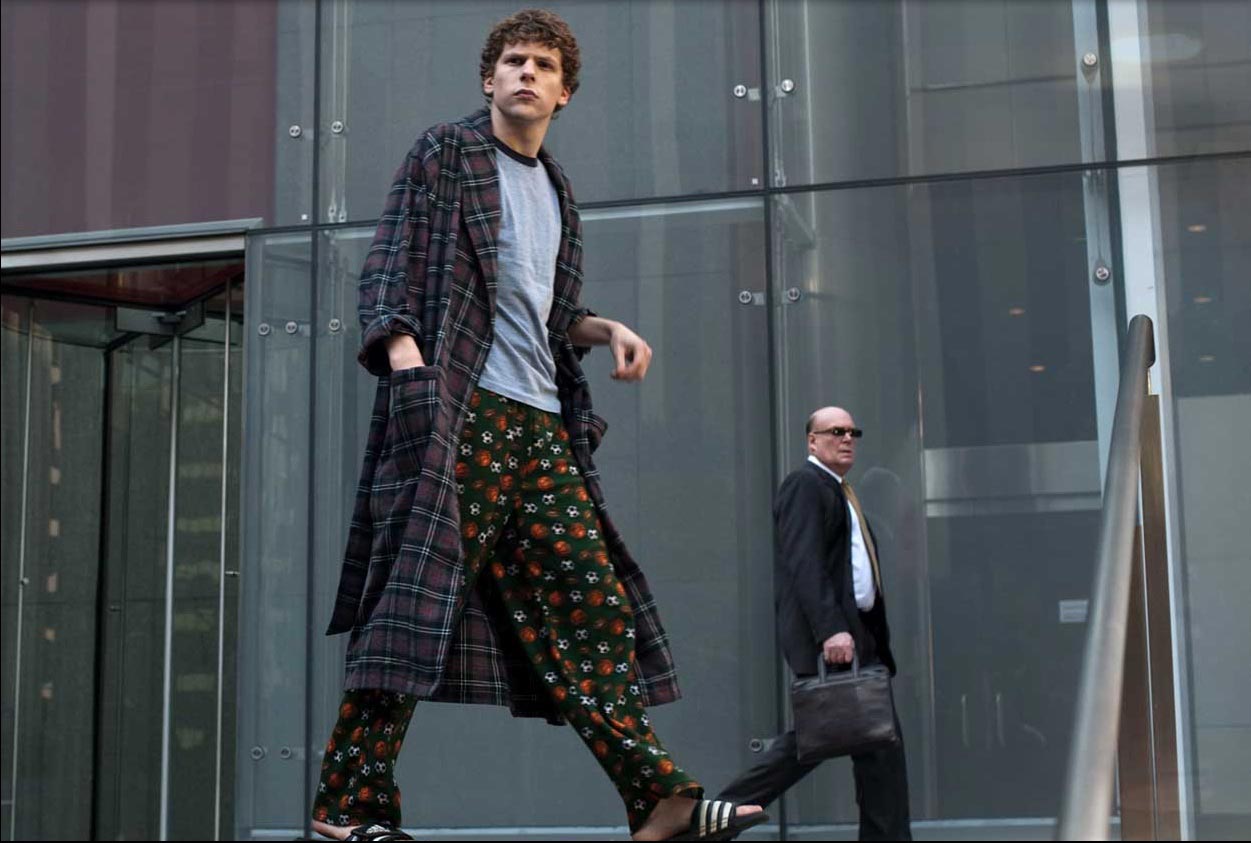
Do I really need to choose between Jesse Eisenberg in The Social Network and Edgar Ramirez in Carlos? Eisenberg, whose performances are usually best described as agreeably nebbishy, revealed a new side to his talent by playing Mark Zuckerberg as a tunnel-visionary, training his laser focus on his conception of Facebook and leaving everything else in his life in the dust. He never makes Zuckerberg likable exactly, but one can’t help but admiring him, as his tireless work for Facebook gives him a strange sort of integrity. Ramirez is equally impressive, giving a performance that spans half a dozen languages (including Arabic, which he learned for the role), and inhabiting the skin of Carlos from his early days as a hungry young revolutionary to his Sudanese exile, a bloated leftover from the Cold War. Ramirez inhabits nearly every frame of Carlos, and the film is damn near unimaginable without him.
8) Most important lesson learned from the past decade of watching movies
If you’re not getting paid to see movies, you don’t need to see anything you don’t want to see. To feel obligated to see movies you could care less about leads to bitterness and disillusionment. Better to watch a dozen movies you’re legitimately interested in than a hundred that you think might be OK. In short, watch what you want to watch.
9) Last movie seen (DVD/Blu-ray/theater)
Last movie on DVD: Jean-Pierre Jeunet’s Micmacs, or as I’ve taken to calling it, Death by Whimsy. Jeunet’s flair for visually interesting set pieces is as strong as ever, but the story isn’t compelling and the characters are fairly dull, if quirky. After about half an hour, I was pretty much worn out, which I’m guessing wasn’t Jeunet’s goal.
Last movie in theatre: James L. Brooks’ How Do You Know. Why isn’t this getting more love? Sure, it’s “messy,” but where the film’s detractors see narrative digressions, I see a unique comic voice peeking through. Brooks is in love with the possibilities of long scenes, and although these don’t exactly move the story along, they work so well unto themselves that I hardly noticed. The hospital scene may be the best scene I’ve seen this past year.
10) Most appropriate punishment for director Tom Six
To be forced to direct- but not write- a big-budget Hollywood star vehicle. The guy knows how to direct a movie, but the attention-grabbing stunts have got to go. Let’s see what he can do with a particularly hands-on star who won’t let him get away with being provocative simply to drum up hype. I’m thinking a cookie-cutter romcom starring Sandra Bullock could do the trick. Failing that, what he deserves most is to be ignored until he gets this “Human Centipede” crap out of his system.
11) Best under-the-radar movie almost no one else has had the chance to see
Jacques Rivette’s Out 1. With all the crap that’s out there on DVD, it’s shameful that this magnum opus by one of the masters of filmmaking hasn’t even gotten a VHS release. Come on, Criterion- get on this!
12) Sheree North or Angie Dickinson
Nothing against Sheree, but there’s only one Feathers, and Sheree ain’t it. Angie Dickinson in a walk.
13) Favorite nakedly autobiographical movie
Do I think that every scene of Buffalo ‘66 was taken from Vincent Gallo’s life? Of course not. I’m pretty sure Gallo never went to jail as punishment for a gambling debt. Yet the scenes involving his parents seethe with the pain of real-life experience. Gallo’s dad was a singer, and Ben Gazzara lip-synchs along with one of his old songs. And Gallo’s character’s strained-at-best relationship with his folks feels like it’s born of real wounds dating back to childhood. I don’t know if that’s the kind of answer you’re looking for, Professor, but it’s the answer you’re getting.
(added 30 December) Oh, OK... if you insist. The obvious answer here is 8 1/2, but I'd like to put in a good word for Passing Strange. Yeah, it's more of a performance film than a straight-up movie, but Spike Lee made the right choice not to adapt it for the screen, since the intimate theatre-in-the-round format works to the material's benefit. And the material is, in a word, awesome. Composer-narrator Stew mines a pivotal time in his life- his artistic awakening and extended sojourn in Amsterdam and Berlin- for genuine feeling as well as great theatre. Most surprisingly, he's able to take that most careworn crutch of the roman-a-clef, his relationship with his mother, and make it feel fresh and complex, by virtue of the complex and unresolved feelings it summons in him. Plus it's just entertaining as hell, from his spoofing of every terrible punk band that never made it out of the garage, to his hilarious toe-tapping American-in-Berlin ditty "The Black One." One of my favorite movies of 2009.
14) Movie which best evokes a specific real-life place
Paris after May ’68 is often depicted as an intellectual wonderland, and to be sure, all evidence points to the idea that it was a hotbed for thought and creativity. But where one finds genius one also finds those who aspire to it, even as they fall hopelessly short. So when I think of Parisian counterculture in the sixties and seventies, I think not of The Dreamers but rather of Jean Eustache’s The Mother and the Whore, which pulls back the curtain on the idealism of the time and reveals a world chock full of layabouts and bullshit artists. Of course, the heyday of the world couldn’t last forever, and it was curdling by the time Eustache made the film in 1973. But that he could be so clear-eyed about the shortcomings of the team even as it was still going on makes The Mother and the Whore both a great film and an invaluable warts-and-all portrait of a key period in modern French history, the last gasp of idealism before malaise set in once more.
15) Best Director of 2010
Yorgos Lanthimos, for Dogtooth. Too often, a young filmmaker seems beholden to his influences. But while Dogtooth feels superficially indebted to directors like Buñuel, Von Trier, and Haneke, Lanthimos has a vision all his own. Just as importantly, he takes some tricky material and handles it magnificently, achieving a perfect balance between absurdism, tragedy, and brutality. It’s a real achievement, and I can’t wait to see what he does next.
16) Second-favorite Farrelly Brothers Movie
Well, my favorite is easily Stuck on You- a strong contender for the most under-loved movie of the past decade, not that you asked. As for my second-favorite, I’d probably have to go with Kingpin, which is the apex of the Farrellys’ scatological period. It helps that they chose a milieu that lends itself particularly well to sleaze- the world of professional bowling, which is gaudy and low-rent enough when it’s on the level, but attains a particularly downmarket flavor whenever hustling is involved. And the actors are nothing if not committed- you can almost smell the stale smoke on Woody Harrelson’s Roy Munson, and it’s nice to see Randy Quaid in his pre-wackjob phase. Then there’s the priceless Bill Murray as “Big Ern” McCracken. This wasn’t Murray’s last straight-up comedic performance, but it feels like the last time he really tried to sell the silly stuff before he shifted into deadpan territory. Good stuff, this one.
17) Favorite holiday movie
All-singing! All-dancing! All-vamping! All-killing! I’m probably alone on this, but I think 8 Women is pretty rockin’. That it takes place at Christmas is reason enough for me to choose it here.
18) Best Actress of 2010
Disabled roles have long been awards-season catnip, but no one would call Sylvie Testud’s performance in Lourdes Oscar-bait. For one thing, it was barely released in this country, so it wouldn’t stand a chance even if it was in the Academy’s wheelhouse. But more importantly, Testud’s performance is so subtle that it’s easy to overlook what a masterful acting job she does. Testud gives a very lived-in portrayal of a quadriplegic woman who decides to tag along with a tour group visiting the titular shrine, and so completely does she inhabit the character that the disability is merely one of the things that makes her so compelling. And so convincingly does she convey the predicament of a woman who is essentially in deep free from the neck down that it’s all the more astonishing when, following a miracle, she almost without thinking reaches out and touches something she never could have before. Testud is one of the most fascinating actresses currently working, and Lourdes offers ample evidence of her acting gifts.
19) Joe Don Baker or Bo Svenson
Haven’t we already had this question? Oh well. Don’t really have a strong opinion about this one, I have to say.
20) Of those notable figures in the world of the movies who died in 2010, name the one you’ll miss the most
A world in which we have no more new Eric Rohmer films to look forward to seems almost unbearably sad.
21) Think of a movie with a notable musical score and describe what it might feel like without that accompaniment.
Alfred Hitchcock shot Psycho with his TV crew, with the goal of making it look like it took place in the workaday world instead of the world of movies. For most of the movie, the only thing giving it an uneasy atmosphere is Bernard Herrmann’s score. Try to imagine Marion running away from Phoenix with no music behind her- much of the urgency would be gone, I dare say. And I’d guess that the famous shower scene wouldn’t be such an effective scare moment without the screeching strings- the visceral effect would be all but gone. But what would suffer most would probably be the post-killing scenes in which the seemingly innocent Norman is repeatedly questioned about the murder. In these scenes, Hitchcock cannily employed the same musical motifs in the earlier scenes involving Marion so that Norman feels like a victim. It’s a clever bit of misdirection that would be lost without the music behind it.
22) Best Screenplay of 2010
As I said above in question (5), I prefer to base my judgments of a movie on what happens between the opening logos and the closing credits. Because of this, I make it a point not to read the screenplays for the films, and consequently I don’t know how to best answer this question. Even something as basic as dialogue is a tough call. How much of what comes out of the characters’ mouth was on the page, and how much came out of shooting? Does the mood set by the film come from the screenplay or direction? How much of the story was constructed in the editing room? And what makes a “good” screenplay anyway? A good story? Good form and structure? Loads of research? Jesus, now my head hurts.
23) Movie You Feel Most Evangelistic About Right Now
Um… Dogtooth!
24) Worst/funniest movie accent ever
What in the hell was John Malkovich going for in Rounders? I mean, I get that Teddy KGB was supposed to be Russian. But while bizarre accents have been a tradition of comedies ever since the days of Peter Sellers, Rounders was intended to be a drama. Did it not occur to John Dahl that Malkovich’s sub-Boris Badenov routine would take everyone right out of the story?
As for deliberately funny accents, I’m a fan of Lambert Wilson’s “real” American and “fake” French accents in Alain Resnais’ Not on the Lips. The British/French Wilson is perfectly bilingual, which makes it all the funnier that his characters’ stumbling attempts at French sound like he’s reading of phonetically-translated cue cards. But just as funny is his chewed-on take on Middle American, which makes him sound like James Coburn with a lip full of Novocaine.
25) Best Cinematography of 2010
Most films that employ digital cinematography use the new medium as a replacement for old-school film. However, there are a handful of filmmakers that have figured out the unique possibilities for digital, and David Fincher is one of them. With The Social Network, Fincher and d.p. Jeff Cronenweth transformed a potentially dry subject- the founding of Facebook- and turned it into a visually startling work by employing technology as current as that upon which its protagonist created his online empire. Most impressive is how Fincher and Cronenweth take advantage of the sharpness of the Red camera to heighten the unique visual textures of the film’s various settings- the burnished halls of Harvard’s “final clubs,” the institutional light of the Facebook offices, the neon paradise of the nightclub where Zuckerberg conspires with Sean Parker, the bong smoke that weighs down the air in Facebook’s California house. Much of the time, it’s historical epics that hog the cinematography accolades, but The Social Network beats them all this year.
26) Olivia Wilde or Gemma Arterton
I don’t have a strong opinion about either one, honestly. Wilde’s face is more interesting, so she’s got the edge there. On the other hand, if I was still single I’d do my damnedest to snag the one-sheet for Tamara Drewe, featuring the memorable image of Arterton in tiny shorts. Then again, I haven’t seen the movie yet, so it’s not like I’m a huge fan. Of course, Wilde was on House, and my lady likes House, so I guess she has the edge.
27) Name the three best movies you saw for the first time in 2010 (Thanks, Larry!)
I don’t get a chance to watch as many older movies as I’d like to, so my list won’t be quite as impressive as some. But instead of answering Dogtooth yet again, here are three oldies-but-goodies submitted for your approval: (1) Sam Fuller’s incendiary White Dog, which I wrote about in detail for the Killer Animal Blogathon, (2) Hou Hsiao-hsien’s epic City of Sadness, a lovely drama about sweeping historical changes in Taiwan, and (3) John Woo’s Hard Boiled, with its awesomely unhinged extended battle in a hospital.
28) Best romantic movie couple of 2010
Most poignant: Kathy and Tommy, Never Let Me Go. Most promising: Lisa and George, How Do You Know. Most toxic: Gitti and Chris, Everyone Else. Hottest: Nina and Nina’s version of Lily, Black Swan. Most tragic: Dom and Mal, Inception.
29) Favorite shock/surprise ending
”You maniacs! You blew it up! Damn you! Damn you all to hell!”
30) Best cinematic reason to have stayed home and read a book in 2010
It’s been almost eleven months since I saw this, but I still shudder a bit to think of the Jackie Chan kiddie vehicle The Spy Next Door. Late-period Chan has been fairly disheartening as a whole, I’d say- age has diminished his once-formidable athleticism to the point where he seems to be angling for the youth audience because he believes they’re the only ones who will still be impressed by his skills. But what makes the movie really egregious is that no one making it seemed to care. It’s as if the studio, producers, director, writers, actors, and everyone else down to the catering department figured that they only had to put in the least possible amount of effort in order to finish the movie and post a decent opening weekend on the road to a DVD release.
Don’t get me wrong- there are plenty of movies out there that feel like quick cash-grabs. But ever since I became a father, I’ve become especially annoyed by lousy movies aimed at kids. After all, children are full of imagination and creativity, two things that should always be encouraged. However, children are also highly susceptible to outside influences- to advertising and promotional tie-ins, to say nothing of peer pressure. So whenever Hollywood hard-sells shoddy goods like The Spy Next Door to children, it’s doing nothing less than grinding down a child’s creative impulses and destroying his ability to distinguish something really special from a run-of-the-mill time-waster (sadly, this is an ability many people find almost impossible to get back, if the ratings for Jersey Shore are any indication).
In short, not only should I have stayed home and read a book instead of seeing The Spy Next Door, but I should have stayed home with the offspring and read with him. At least then an extra precious little sliver of imagination in his brain might have survived a little longer.
31) Movies in 2011 could make me much happier if they’d only _______________ … ”release Tree of Life already.” Which it looks like they’re planning to do, so I’m at a loss for a better answer. Let’s see… “movies in 2011 could make me much happier if they’d only make it easier for me to watch the best new releases with my lady without having to plan ahead, pay for a sitter, etc.” Yeah, I guess that works.
Luca Guadagnino’s I Am Love is nothing if not ambitious. In interviews, Guadagnino and his collaborator and leading lady Tilda Swinton have stated that they wanted to resurrect the old-school melodramas of Douglas Sirk, a genre that has fallen on hard times as critics have used the word “melodrama” as a club to beat down films that traffic in larger-than-life emotions over “realism.” And Guadagnino and Swinton have a solid starting point for their goal in their story of a privileged Russian-Italian woman (played by Swinton) who tumbles into an affair with her son’s best friend. Trouble is, Guadagnino can’t muster up the emotional highs required of his chosen genre. Swinton is fine- she’s completely convincing in two foreign languages and her alien presence makes it clear she doesn’t fit into the upper-class world into which she’s married. But in the end, the film lets her down, as Guadagnino allows external signifiers- weather changes to reflect tonal shifts, John Adams’ memorable but suffocating score- to signal what ought to spring organically from what’s happening in the characters’ lives. What’s more, Guadagnino aims to make I Am Love a feast for the senses, but aside from a key scene in which Swinton tucks into a prawn dish her lover-to-be has prepared for her, Guadagnino’s “sensual” images to little more than invite a reaction of “ooh, purty.” Which, I mean, yeah, but in more capable hands they could have been so much more. To imagine what a sensualist like Bernardo Bertolucci or even the Martin Scorsese who gave us the indelible image of a razor slicing through a clove of garlic is to weep a little at what I Am Love might have been. Rating: 5 out of 10.
If I Am Love invites audiences to taste its every dish and feel its every texture, then Danny Boyle’s 127 Hours and Darren Aronofsky’s Black Swan have another sympathetic sensation in mind- pain. Much of the hype for 127 Hours has reckoned with its true-life premise, in which lone-wolf adventurer Aron Ralston got pinned between two rocks for more than five days and eventually freed himself by hacking off his trapped arm. On paper, the concept seems like it would lend itself to a spare, Gerry-style treatment in which the director maroons the audience with Ralston (played by James Franco), all the better to feel his isolation and appreciate what he does and doesn’t have to work with in the situation. Instead, Boyle amps up his filmmaking like a film student jacked up on Mountain Dew, employing jackhammer editing to cut between Ralston’s plight in the canyon and his memories and fantasies about the rest of his life. Sometimes, this tactic pays off, as when he ponders the little mistakes- not telling anyone where he was headed, leaving a bottle of Gatorade in his Jeep, forgetting his Swiss Army knife- that got him in his situation. But just as often, the cutaways are distractingly unsubtle, as Boyle and cowriter Simon Beaufoy hammer home the point that, yes, Even Aron Ralston Needs Other People. That said, James Franco is pretty brilliant here, and it’s easy to imagine a more minimalistic approach working in his capable, um, hands. And that “money scene”- ouch. (Especially the sound.) Rating: 6 out of 10.
Like The Wrestler, Darren Aronofsky’s last film, Black Swan’s primary theme is the extent to which people will push themselves for their chosen art. In Black Swan, that art is ballet, and one of the most compelling aspects of the film is observing at close range how much of the grace of dance comes from forcing the body to bend in directions it simply wasn’t meant to go. But Black Swan also deals with the mental distresses that its heroine Nina (played by Natalie Portman), an up-and-coming dancer in the Metropolitan Ballet, faces when she takes on the bifurcated lead role on Swan Lake. As the troupe’s leader (Vincent Cassel) tells her, her impeccable porcelain style is ideal of the White Swan, but she has more trouble with the Black Swan’s heedless abandon, so he encourages her to let her darker side loose. One of the common threads in Aronofsky’s work is psychology manifesting itself physically, and true to form, Nina’s discovery of her own darker side leads to a bodily transformation into the Black Swan. Or does it? This does-she-or-doesn’t-she enigma is one of its least interesting aspects, not so much because of its ambiguous nature but because it feels like a lack of nerve on the film’s part. However, it must be said that this lack of nerve isn’t something shared by the film as a whole, as Aronofsky embraces the Grand Guignol style needed to really sell a story of this nature. And if much of Black Swan feels like pieces of other films- the dancer-swallowed-by-the-role storyline of The Red Shoes, the freakish imagery of Repulsion, the mother-daughter dynamic of The Piano Teacher- then at least Aronofsky chooses his influences wisely. Like the Met’s production of Swan Lake in the film, Black Swan takes classic influences and makes them fresh and exciting. Rating: 8 out of 10.
Of course, the credo of “everything old is new again” is one that’s shared by Tron: Legacy, an eye-popping sequel to the 1982 cult classic whose primary appeal seems to be to those who weren’t even alive when the original was released. This isn’t idle speculation either- I attended the screening with the Offspring, who’s almost ten years old, and as the credits rolled he proclaimed the movie one of his all-time favorites. I don’t agree with this assessment, mind you, since for one thing the movie’s exposition-heavy script doesn’t live up to the visuals. However, it’s easy to see why Tron: Legacy would hit a grade-school-aged boy’s sweet spot. For one thing, the action sequences are pretty killer- the Light-Cycle sequence honors the original film while upping the ante, as the cycles speed up and down ramps and even careen through the air, and they shatter when they collide. And that’s a mere warm-up for the climactic Light-Plane battle, which is pretty mind-blowing, all the more so because neophyte director Joseph Kosinski has a good feel for directing and cutting action sequences. But beyond the action (and of course the effects), Tron: Legacy is an instant grade-school classic for the way it incorporates enough “mythology” into its storyline to make the film feel weightier than the usual blockbuster fare, and for its female lead Quorra (Olivia Wilde), who’s beautiful but sexless, and who’s written as more of a best pal than a love interest. Alas, Tron: Legacy never hits the heights of a film like Speed Racer, which works so well because the Wachowskis were assured enough filmmakers to commit to the film’s flashy aesthetic, while Kosinski is still working his way to that point. What’s more, he doesn’t have the same flair for directing actors as he does with visuals, as the film’s performances are all over the map (Jeff Bridges’ aged Flynn is basically a Zen Dude, Garrett Hedlund’s Sam is a colorless rebel-hero, and Michael Sheen’s Bowie riff is fun but sort of stops the movie cold). Still, if Tron: Legacy doesn’t break new ground as narrative, it’s pretty exciting as pure spectacle, and if nothing else it uses IMAX 3D in a way that actually works instead of simply cashing in on the fad. Rating: 6 out of 10.
The courts of critical (46 on Metacritic) and public (#8 at the box office its opening weekend) opinion have already weighed in on James L. Brooks’ How Do You Know and found it largely wanting. However, I think I could be forgiven for wanting to say a few words in defense of this most welcome rarity, a big-budgeted romantic comedy with a genuinely unique voice. More specifically, instead of utilizing the narrative efficiency found in more films of the genre, Brooks focuses on the messiness of his characters lives and makes that the crux of his film. Naturally, the film’s premise- two people having their first date on the worst day of their lives- is straight out of high-concept hell. But Brooks takes his characters’ problems, and their resultant neuroses, seriously instead of making them cutesy or the subject of easy jokes (this in itself makes it a welcome corrective to Brooks’ misguided Spanglish, which contained two super-duper-perfect characters and one character-Tea Leoni’s- who was neurotic to the point of grotesquerie). Observe Lisa (Reese Witherspoon) as she struggles to find her way after being cut from the USA softball team, attempting to forge her own new identity instead of simply “settling down.” Or look at the way George (Paul Rudd), no doubt tired of his father’s (Jack Nicholson) manipulations, decides to let both his fate and that of his father hinge on the outcome of a meeting he’s scheduled with Lisa. Then there’s that wondrous scene in which a man we’ve never even met previously makes a spectacularly convoluted proposal to the woman he loves following the birth of their son (a front-runner for my favorite scene so far this year). By conventional standards, How Do You Know is an unholy mess, but to hell with conventional standards. It’s pretty magical- certainly Brooks’ best work since Broadcast News- and I suspect time will be extremely kind to it. Rating: 8 out of 10.
Finally, a couple of bite-sized assessments… Lena Dunham’s Tiny Furniture has won legions of admirers for its handmade feel and its portrayal of post-graduate malaise, but the subject matter isn’t nearly as interesting as Dunham seems to think it is, and she does nothing to elevate it aside from throwing in plenty of quirkiness. Inspired in bits (like the world’s worst hookup), but exhausting at feature length (4 out of 10)… Neil Jordan’s Ondine won’t win the director any new fans, but it’s an unassuming charmer. Some of the plot manipulations in the second hour are fairly creaky, but the photography is beautiful without feeling scenic, and Farrell continues to grow as an actor (6 out of 10).
Harry Potter and the Deathly Hallows, Part I (David Yates)- by now, most moviegoers have formed a more or less ironclad opinion on the Potter franchise, and Deathly Hallows the First is not a movie that’s going to change people’s minds. But for those who’ve been following the series to date, this seventh installment provides a compelling contrast to the previous entries. A lot of this is due to Harry and the gang being removed from their usual setting- the film lacks the comfortable structure of a school year at Hogwarts, with the attendant classroom misadventures, relationship troubles, and everything else that implies. Here, Harry and his friends are no longer insulated from the magical world as a whole, and their having to make their own way leaves them far more vulnerable, thereby adding a new urgency to the film that wasn’t there previously. That said, like most of the other Potter movies, the filmmaking is more staunchly professional than inspired, and the storytelling, even with the necessary cuts to the source material, feels as dutiful and slavish as ever (also, I despair that of all the Potter directors, only Cuaron was able to locate the grey area between whimsical wondrous “good magic” and the sinister Dark Arts). Still, while it’s not great cinema, it’s one of the better entries in the Potter series, and sets up next year’s allegedly final installment pretty well. Rating: 6 out of 10.
Legend of the Guardians: The Owls of Ga’Hoole (Zach Snyder)- If nothing else, Guardians deserves to be seen for its pure visual splendor- the geniuses at Animal Logic have created a richly detailed and immersive world for this film completely out of 1s and 0s, and Snyder’s visual bombast is surprisingly well-suited to animated fantasy. It’s sort of a pity then that the rest of the movie falls short of its images. Guardians’ screenplay comes off mostly as a standard-issue fantasy formula- only, you know, with owls- and consequently the storyline of the film contains precious few surprises. This wouldn’t be such a glaring issue for me if Ang and I weren’t currently reading the Ga’Hoole books with the Offspring, in which much of the story is focused on the workaday details of its characters’ lives- for example, young hero Soren and his friends attend classes after their arrival in the Ga’Hoole tree, but while Snyder treats these classes as snippets in a montage, author Kathryn Lasky takes time to lay out the content and context of their lessons (I’m a procedure guy, what can I say). Snyder, never a particularly deep thinker, also fails to wrap his mind around the ambiguity of the film’s battle scenes, in which the peace-loving intellectuals from Ga’Hoole fight to prevent the owls of St. Aggie’s from spreading their evil agenda throughout the world. Instead, his attention is solely on the choreography of battle, with all the slow motion and lingering shots that implies. And yeah, the battles are visually stunning- the whole movie is, really- but if Snyder would pay as much attention to his characters and their thoughts as he does to every feather and leaf, Guardians might be worthwhile as more than just eye candy. Rating: 6 out of 10.
The Square (Nash Edgerton)- the signature image of this Aussie neo-noir is the face of its protagonist, Raymond Yale (played by David Roberts). A middle-aged man in a dead-end marriage, Ray has a worn and weary-looking face, with deep lines framing a mouth that’s in a perpetual scowl, and a brow that only seems capable of expressing anxiety. But then, there’s little to express in The Square, set in a world of crooks and shady sorts that exists largely to be escaped. We’re in Coen brothers territory here, particularly the Coens of Blood Simple and No Country For Old Men, and Edgerton does a solid job setting the tone so that there’s little hope even before things start to get really, really bad (which of course they do). But while The Square is a solid genre piece, it’s rarely more than that, both because its tonal range is so narrow and because the screenplay is tragically short of the sort of vivid characterizations that distinguish the film’s influences. Consequently, The Square comes off less as a free-standing creation than as a demo reel for its maker. It’s an efficient machine, but it falls short when it comes to honest-to-goodness vision. Rating: 6 out of 10.
Enter the Void (Gaspar Noé)- of course, there’s plenty of vision to go around in Noé’s latest, a dazzling formal experiment in which we follow a man’s soul as its leaves his body after death. Much like in Irreversible, Noé makes extensive use of an ever-moving camera and invisible edits, and he shoots almost entirely from a first-person perspective, all the better for us to experience the protagonist’s “death trip” through his own eyes (so to speak). Noé has always been a bold filmmaker, and it’s this boldness that allows him to find transcendent moments in a narrative that otherwise might come off as morbid or maudlin. Trouble is, these transcendent moments are inextricably linked to ideas that are, to put it mildly, sort of dopey. The primary thematic inspiration for Enter the Void is the Tibetan Book of the Dead, but there are very few ideas on display here that aren’t expressed more artfully- and succinctly- in Revolver-era Beatles songs like “She Said She Said” and “Tomorrow Never Knows” (which was originally titled “The Void”, dontcha know). And while it’s admirable of Noé to sustain his formal experiment far longer than most directors would have, the truth is that at upwards of 2 ½ hours, Enter the Void wears pretty thin after a while. Still, no one is making movies like this nowadays, and if I have to sit through two-odd hours of tedium in order to experience a strange and magical image like two people making love while soft colored light wafts from their coupled genitalia, I’ll make the sacrifice. At least I’ll know I’m in the hands of someone who’s trying something new and different, and who isn’t afraid to fail big. Rating: 6 out of 10.
Chloe (Atom Egoyan)- That’s more than I can say for Egoyan, who back in the nineties was one of the world’s most acclaimed filmmakers before losing his way in this past decade. Nowadays, Egoyan appears to be following the Scorsese template of “one for me, one for them,” which isn’t a bad way to sustain a career as a filmmaker, but which doesn’t seem to be working for him. Even more than Where the Truth Lies, Chloe is a baldly commercial project- a remake of the forgettable French drama Nathalie…, with a screenplay written by someone else. For the first two-thirds, Chloe is sort of effective, as Amanda Seyfried’s titular prostitute spins yarns to suspicious wife Julianne Moore of her husband’s (Liam Neeson) infidelity, and Moore finds herself both angered and turned on by the revelations. It’s a fairly good idea for a movie, and I can imagine Egoyan making something really striking had he made a film entirely of the conversations between the two women. Unfortunately, Chloe is far too conventional for this, and after about an hour of humming along fairly serviceably, the film degenerates into Fatal Attraction territory, with Chloe falling hard for Moore’s character and doing everything she can to insinuate her way into her family’s life. Chloe is never a great movie, but it’s still disappointing to see the bottom fall out of it, especially considering that its maker should have known better. But hey, naked Seyfried is worth a rental, right? Rating: 4 out of 10.
Additionally, I’ve seen plenty of other movies lately that I haven’t had the chance to write about (sorry buds). Some brief thoughts… I’m sort of intimidated by the prospect of reviewing Olivier Assayas’ Carlos, mostly because there’s so much movie there, not to mention that compared to most movies of its sort it feels pretty free-form. It’ll take me at least a second viewing to suss out how I feel, but the filmmaking brilliance on display is undeniable [8 out of 10]… RED commits the grievous sin of assembling Morgan Freeman, Helen Mirren, John Malkovich, and Brian Cox and giving them almost nothing to do that’s actually interesting. I mean, really- why should we care about Bruce Willis and Mary-Louise Parker’s childish flirtation when these four great actors should be running the show? [4 out of 10]… Soul Kitchen essentially takes every cliché of the ethnic crowd-pleaser genre (restaurant division) and livens them up with lots of style and panache, courtesy of director Fatih Akin. It’s nothing you haven’t tasted before, but it goes down easy. Soundtrack is pretty kickass too [6 out of 10]… there’s not much I can say about The Oath that the great Michael Sicinski hasn’t already said, but I was most interested here in how Poitras portrays Abu Jandal, the former Al-Qaeda operative-turned-taxi driver. He’s a wealth of contradictions, and I found him pretty fascinating [7 out of 10]… likewise, I’m fascinated by the complexities of the late Pat Tillman, and the best parts of Amir Bar-Lev’s The Tillman Story embrace these many sides. Sadly, the film itself isn’t so multifaceted, but it’s still a worthy portrait [7 out of 10]… having sat through my share of business courses in the last few years, I was somewhat less surprised by the revelations found in Inside Job than most audience members, but if you want a single-serving primer of what went wrong in our economy, this’ll do nicely [6 out of 10]… finally, jackass 3D is more of the same, and even if it never quite hits the high points of number two, it’s still entertaining as all hell [7 out of 10].
As you may recall, last fall Muriel had some health problems last fall after she contracted an infection in one of her eyes. Needless to say, it was a pretty difficult time for me, and back then I didn’t know if she would make it. Once I saw her condition, I knew I would have to get it taken out, but because of the pain she stopped eating almost completely, and I ended up having to take her to the veterinary hospital to get them to make her eat again. My most vivid memory of this was from the drive to the hospital. I drove with one hand on the wheel and the other petting Muriel in her box, and again and again I did my best to reassure her. I’ve always been the sort of person to talk to animals as if they could understand, and before we entered the hospital, I looked down at her and said, “I’m going to make sure you’re not in pain anymore. No matter what, I don’t want you to hurt.”
While I waited for the doctors to finish working on Muriel, I reconciled myself to the idea that she might not survive her illness. I even said “goodbye” to her before they took her back to the examination area, just in case. So when she started to eat again, putting back on enough weight that she could have the infected eye removed, I was naturally grateful. As you already know, she survived that surgery as well. After she recovered from the illness and became her ornery self again, we started joking around the house that she was indestructible.
Of course, this wasn’t true. Guinea pigs are small and fairly fragile creatures, and their life span averages roughly four years. When she fell ill again last weekend, it had been a little over four years since I first brought her home, and she had lived to a fairly good age for her species. And because guinea pigs are so delicate, I didn’t want to run the risk of putting her under the knife again. After all, we had fought off death together once already, and I didn’t want to risk tempting fate again. So instead, I decided to spend one last night with my Muriel, cradling her to my chest as I gave her water from her bottle. If I was really going to have to say goodbye, I wanted to do it at home, surrounded by the family (human and canine alike) who had grown to love her these past four years. And when she passed away in her sleep that night, I thought that was just about the best she could have gone, much better than I feared would happen when she was sick last year.
Goodbye, Muriel. Thank you for being part of my life.
Sad news for you Muriel lovers- our little girl, who graciously lent her name to everyone's favorite online movie awards, passed away during the night at the age of 4. I'll try to post some thoughts about her soon, but until then here's a link to an appreciation I wrote about her prior to the 2009 Muriels:
So as some of you regular readers may have noticed, I don’t have a great record of sticking to projects I set up for myself. To wit- almost four months after the final of this year’s World Cup, I still have yet to pen a review of my promised World Cup of Cinema-winning title, Carlos Saura’s Blood Wedding. Now, this isn’t entirely my fault- despite repeated attempts at writing something substantial about it, it’s just not a film that lends itself to being reviewed. After all, it’s basically rehearsal and performance footage of a flamenco ballet, which would most likely result in something that does little more than combined plot synopsis with historical context, much as a Wikipedia might. Not exactly scintillating criticism, you might agree.
Yet this isn’t exactly unprecedented in this history of the blog. After Screengrab cast me to the winds last year, I decided to keep myself regular by launching a project called Criterion Watching, which since June 2009 has had exactly two (2) installments. And the less said about my much-ballyhooed “Nobel Project,” in which I set myself the goal of reading something by every Nobel Literature laureate and reviewing it, the better.
Of course, if I was a cynical prick I’d say to hell with it and that I don’t owe my readers anything. But that’s not true. After all, a blog isn’t meant as a soapbox, nor is it a kind of one-sided communication a la Glenn Gould’s 1:0 performer-to-audience relationship. No, it’s an open line of communication between the host blogger (that’s me) and his readership, both the regulars and the folks who stumble upon the blog almost by accident. And because I value you folks, the last thing I would want to do is alienate you.
So I won’t go about setting myself any more long-term projects in the foreseeable future. After all, I’m a busy guy, and I’d prefer not to renege on any promises. Instead, I’ll make a promise that I’m fully prepared to keep. As a wholly amateur writer, I reserve the right to write about whatever I want, and nothing I don’t, and in return, I’ll do my level best to make every post worth your time. If I don’t think something I write is worthy, I won’t post it. Sure, this will no doubt mean that the content turnover will stay fairly low, but I can deal with that if it means I can keep it at a high level of quality. And in the long run, I think we’ll all be better off for it.